The Primacy of Relationships and the Challenge of Peer Pressure – Part 1

Relationships are everything to human beings, as we have discussed in earlier posts. What we do not spend enough time discussing is the power of peer pressure and how it affects relationships, learning, development, and self-esteem of our students.

All human beings are subject to peer pressure and this is especially true of school-aged children. This was true when I was a kid but, today, that pressure is magnified by the ubiquitous nature of social media. Has it ever been more powerful than it is in present times? We will come back to that thought.

One of my all-time favorite teachers was Mrs. Swartz, my seventh-grade social studies teacher at Johns Hill Junior High School, in Decatur, IL. The fact that I remember so much of what Mrs. Swartz said and taught should illustrate how much of an impact she had on my life. She was my favorite teacher and I truly believed that I was her favorite student. I looked forward to 4th period every single day.

One day she began a period by sending one of the class’s best students to the library for a pre-arranged visit to pick up literature of some kind. As soon as our classmate left the room, Mrs. Swartz drew five lines on the black board. Four of the lines were the same length and one was noticeably shorter. She then proceeded to explain to the class what we would do when our classmate returned from the library. No doubt, some of the teachers reading these words have conducted the same exercise.

Mrs. Swartz explained that the purpose of the exercise was to test the power of peer pressure. She asked us to say yes when asked if the lines were the same length. She also asked us to predict what our classmate would do when it was his turn. Would he report what was obvious to see, that one line was shorter than the others or, would he succumb to peer pressure and go along with his peers?

Because he was one of the smartest and most popular students in our grade, my classmates and I were almost unanimous in our belief that he would say that one line was shorter. We all watched with growing anticipation as Mrs. Swartz worked her way around the classroom and we observed as each kid announced, without a moment’s hesitation, that all five lines were of equal length.

When, finally, it was the turn of the subject of our experiment, we were stunned to hear him say, as did we all, that the lines were of equal length. As we sat in disbelief, our teacher finished her trek around the classroom so that every student had an opportunity to respond.

Taking care not to embarrass our classmate, Mrs. Swartz proceeded to explain peer pressure, noting that it has the power to affect everyone, even one of the most intelligent and independent students in our class. She asked our classmate how he felt during the exercise and he said he was confused when, one after another, we all announced the lines were the same length. He said, “it didn’t make any sense, so I just kept staring at the lines, trying to understand why I was seeing something different than everyone else.”

As she questioned him, he described being pulled in opposite directions. Part of him wanted to say “ we were all crazy and that line number five was clearly shorter than the others. Another part of him felt pressured to go along with the crowd.”

He then laughed and we all laughed with him, but his was loudest of all.

Even in such simple situations, kids feel pressure to conform to the ideas and behavior of their peers and it is this writer’s assertion this has never been truer than it is today. All educators and parents are aware of this pressure but how many formal strategies exist to help protect kids from this incredible force that diverts and distracts them from their priorities? The answer is that very little is done to deal with the power of the peer group.

There is an interesting side note to this story from 1959. It  was not until the next year, when my friends and I were talking about how much we missed having Mrs. Swartz as our social studies teacher, that I was stunned to learn that every single one my friends truly believed that he or she was Mrs. Swartz favorite student. It  made us love and miss her even more.

What if we could give every child a Mrs. Swartz and allow him or her to keep her as their teacher for 3 or even as many as 5 years? What kind of an impact would that have on a child’s emotional and learning development? What if we could help more young people develop a powerful self esteem that would enable them to make sensible decisions and stay focused on their priorities, even in the face of negative peer pressure? Providing such an environment is one of the purposes of The Hawkins Model©.

Understanding Education as a Process and Our Schools as Organizations: and a Shout Out to Ted Dintersmith

There are many new and exciting things happening in some schools: innovative education methodologies, ever more sophisticated technologies, and curricula that are being challenged and re-examined.

Recently, our friend @tracyscottkelly shared a teacher’s ( @HJL_Greenberg ) enthusiastic Tweet about Ted Dintersmith’s book, What School Could Be. Kelly acknowledged, as have many of us, that @dintersmith has provided a wonderful compilation of innovative education programs in real American schools.  It is a great read and if you haven’t done so, put it at the top of your reading list.

Let us not lose sight of Dintersmith’s title, What School Could Be, however.The book is not about “what all schools are.”

Dintersmith’s book offers  examples of public schools and school districts that are producing exciting results for their students. These schools and their programs provide shining examples that give hope to teachers and other educators who are feeling overwhelmed by their own challenges and those of their students.  

Let us, also, not forget that Ted Dintersmith traveled through all fifty states to find these innovative education programs, approaches, and methodologies.It is vital that we acknowledge theses schools are the exceptions and do not represent the reality that is public education in many of the other schools in those same fifty states.

Think about how we arrived at present day with respect to public education.At some point in the distant past, schools may have been established to enable teachers to meet the unique needs of children, but over the decades, schools have devolved into one-size-fits-all service delivery providers.  Schools in the U.S. are organized for operational efficiency, based on financial constraints. That the unique needs of our nation’s children have never been as complex as they are now, creates a recipe for failure for millions of kids.

No matter how hard they work or how deep their commitment, teachers cannot alter the aggregate reality that is public education in America and they must not be blamed.

Each of the noteworthy programs from around the nation exists because of the extraordinary efforts of educators willing to step outside the boundaries of education tradition; often against the forces of doubt.  Sadly, these schools are not the norm and millions of American children do not enjoy the benefits of such programs nor are they likely to benefit, any time soon.  We can only hope that as more educators and school administrators are inspired by the examples of “what could be,” they will step out of their comfort zones and take a paradigm leap.

In my education model, my 2013 book, Reinventing Education, Hope, and the American Dream, and my upcoming book with a working title, Reinventing Education One Success at a Time: The Hawkins Model, I have examined our schools from the perspective of an organizational leadership consultant asking the question, “are schools structured to produce the outcomes we so desperately need?” Most often, the answer is that they are not.

The paradigm leap that is needed, if we are to transform public education in America and restore the American dream, is a willingness to remind ourselves that schools are human organizations incorporating an “education process” designed to deliver a service.

If we are dissatisfied with the quality of the service our education process is producing, we must take a giant step back to a point from which we can examine the education system as an integral whole.We must, then, stop looking for someone to blame and, instead, challenge every single one of our assumptions. Only then can we start from scratch and reconstruct an education system—both structure and process—to produce the outcomes we want and need.

What is it that we want and need from America’s public schools? We need an education model or process in which our dedicated teachers can help every child have more than just equal opportunities—they must have the wherewithal to develop their own dream, envision their futures, chart their own paths, and seize those “equal opportunities.”

At the root of every problem facing American society—whether social, political, economic, technological, ecological, or criminal justice—is the fact that far too many young Americans are not equipped with the understanding, knowledge, skills, self-esteem, and self-discipline to seize the opportunities to which they are entitled, constitutionally.It all comes down to the efficacy of our education process as a whole and not whether a few schools might be succeeding.

What the Data Tells Us

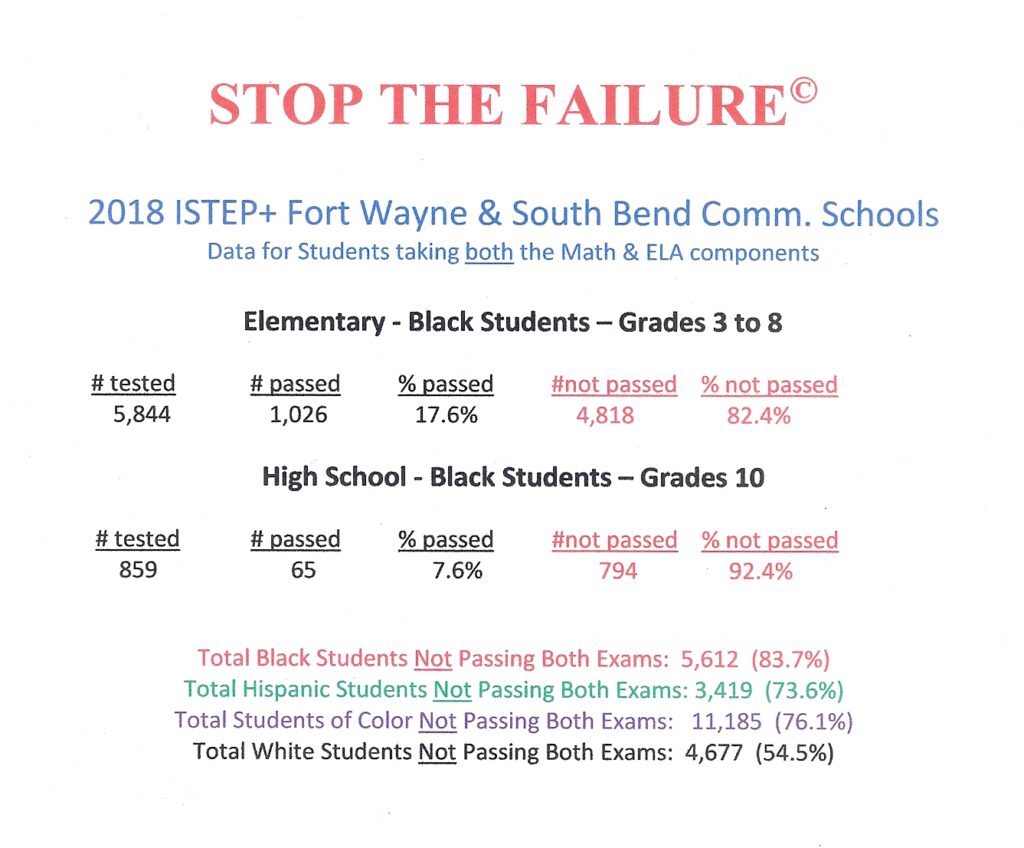
The following graphic speaks eloquently about the problems in public education in America; problems that exist in spite of the heroic efforts of teachers.

Fort Wayne  and South Bend are two of Indiana’s greatest cities and both have many cultural, educational, business, and recreational resources to offer to their citizens. As is true in so many medium- to intermediate-sized communities (populations of 100,000 to 300,000), both communities have diverse populations. What is also characteristic of such communities is the existence of  urban, suburban, and rural public-school districts. Both Fort Wayne Community Schools and the South Bend Community School Corporation, within their district boundaries, have a high proportion of children of color; children from families that are on the lower end of the income continuum, regardless of color; and, the largest percentage children for whom English is a second language. By virtually any criteria, in diverse communities, both have the highest percentage of kids that could be thought of as disadvantaged students.

Both school districts are led by some of the most highly educated and experienced administrators in the State of Indiana. They are staffed by a diverse faculty of teachers who have been educated in the nation’s finest colleges and universities and who are represented by the same unions and associations as their colleagues from Indiana and around the nation. Teacher salaries are within the same range as other area school districts that compete for qualified teachers and typically exceed teacher salaries the community’s parochial schools offer.

These school districts also offer a variety of programs for students with a broad range of special needs. And, so there are no misunderstandings, they teach to the same academic standards as must teachers in every other school in their state. They also continue to make the best investments in their school buildings and equipment as their constituents will permit.

Both cities have been my hometowns in major parts of my life, and I am proud to have lived in South Bend and Fort Wayne, Indiana. I graduated from one of the two districts, as did all three of my younger siblings, and I spent the greater part of my life and career in the other. All three of my children attended and graduated from Fort Wayne Community Schools and went on to earn both undergraduate and graduate degrees in their chosen fields of interest. There, I also spent ten years as a substitute teacher.  Although my wife and I are in the process of moving from Fort Wayne, that decision had nothing to do with the quality of life offered by the community. We will always love Fort Wayne.

We have the greatest possible respect for the dedicated teachers and administrators of both school districts. We also have a family member who is a principal in one of the school districts and who strives, every day, to make a difference in the lives of his students.

The graphic is offered to illustrate how the combined student bodies from these fine school districts struggle, academically, despite the heroic efforts of public school teachers, not because of them. In this post, I will provide only a few highlights of the data and what I believe they tell us . My new book will allow readers to delve more deeply in the data.

These two school districts are like a thousand other school districts of comparable size and demographics and this just begins to reveal the sheer size of the crisis in public education in America. If we take the total number of students that are struggling in these two districts, divide that number by two, and then multiply it by the estimated one thousand school districts in America of comparable size and demographics, we are talking about eight million school children. Let me repeat that number: approximately 8,000,000 kids.

Add numbers from the roughly fifteen thousand other school districts in the U.S. that are smaller, larger, richer, poorer, and more segregated and the numbers are both staggering and compelling. Anyone who denies that we have a crisis in public education in America must be challenged to take another look and, yes, the degree to which the validity of state competency exams is questioned, is understood.

            The only reason to question the validity of state competency exams is that they are utilized to evaluate the quality and effectiveness of teachers and public schools and this author shares the conviction that their use for that purpose be categorically rejected.

            What educators dare not reject, however, is that, with all the imperfections of standardized competency exams, they are still a measure of the ability of children to demonstrate their mastery of the subject matter set out for them by academic standards of their state.

            MOST IMPORTANT OF ALL, THESE RESULTS ARE A MEASURE OF THE EFFECTIVENESS OF THE EDUCATION PROCESS WITH WHICH TEACHERS AND SCHOOLS ARE EXPECTED TO EDUCATE OUR NATION’S DIVERSE POPULATION OF STUDENTS. I CHALLENGE ANY PROFESSIONAL EDUCATOR, WHO DISPUTES THESE DATA TO LOOK INTO THEIR OWN EYES IN THE NEAREST MIRROR AND TELL, FIRST THEMSELVES, AND THEN THE AMERICAN PEOPLE, THIS IS THE BEST WE CAN DO.

            The essential purposes of this work is to show that this is nowhere near the best we can do for our nation’s children, and to offer a solution. It is a solution engineered to give every child a quality education to develop the knowledge and skills they will need to identify and then pursue their dreams and aspirations. Equality in education is the categorical imperative of our time.

            The other essential purpose of this work is to give the millions of men and women who have chosen to serve our nation and its children as educators, an education model that will allow them to become the teachers they envisioned when they chose to enter this demanding profession. They chose teaching because of their desire to make a difference in the lives of kids and in their communities and we must enable, not just allow, them to do their jobs to the absolute best of their ability.

It is this author’s sincere belief that there is nothing we can do as a society that will have a greater impact on the quality of life of the American people, both individually and collectively, than creating an education process that will prepare all our young people to meet the unprecedented and unimaginable challenges the balance of this 21st Century will present.

Work on my new book is well underway and it will lay out the education model I have created in great detail. In the interim, the reader is invited to view the latest version of my education model at https://melhawkinsandassociates.com/education-model-white-paper/

You will also find a copy of the white paper written to lay the logical foundation for the model. Please read not in search of reasons to reject rather so you might envision what it would be like to teach in such and environment. Please share it with your friends and colleagues.

There is a need for transformational change in public education, but do we have the will?

If you are teacher, do you see anything on the horizon that gives you reason to expect the daily stress you endure will be lessened and the success of students will be assured?

Recent studies have found that American classrooms can place teachers under stress; often debilitating stress. This is not news. Teachers and their most capable leaders have known this for decades. If non teachers would spend just one day in the classroom of a Kindergarten, first, or second grade teacher, with more students with which any one teacher should be required to deal—students with wide disparity in academic preparedness—they would experience real stress; from the first bell to the last, each and every day.

We could say the same thing about the desired academic achievement of students. Every meaningful measure of academic achievement conducted over the past few decades has demonstrated that children of color, with economic disadvantages, and for whom English is a second language, struggle. How we justify ignoring this data for so long is difficult to understand.

Like all the challenges facing public education, stress and low achievement are symptoms of dysfunction and obsolescence; it is systemic.

As a teacher, you cannot change public education in America from your classroom. Just doing your job requires more than most people outside the field of education can imagine. Systemic changes to public education in America, however, cannot happen without your individual and collective advocacy. Your unions and associations can be powerful forces to drive positive change, but it is never enough to register complaints and protests. Instead, be a powerful advocate for a positive, new idea.

If you are a principal, you lack the authority to act unilaterally even if you had a solution yet you, too, can be a positive advocate for change. Seek support from your colleagues and from your professional associations on a state-wide or national scale. Complaints and protest are the tactics of the powerless, however, even for administrators. What we need from principals and administrators is for them to rally around a positive solution to the challenges facing our public schools and urge their districts to act.

Superintendents for school corporations and school districts have a clearly defined responsibility to provide the highest possible quality of education to the children within their district’s boundaries. If you are fortunate to lead an affluent school district with historically high achievement, you may feel confident that a quality education is exactly what each of your students receives. You also know that not all your colleagues and their school corporations are so fortunate.

Teachers, administrators, and school boards have not come forward with an alternative approach that can transform public education in America and neither have policy makers and state legislators. They have not found a solution because they are not looking outside the boundaries of conventional wisdom. And, no, school choice and charter schools are not the answer. Charter schools are a diversion that distracts us from what should be our primary focus. We must find a new, comprehensive, and integrated process that works for every child, whatever their unique requirements, and supports rather than impedes the efforts of every teacher.  We need all educators and public officials to open their minds to the possibility of a better way. Then, we need educators, at every level, to use their individual and collective power as positive advocates to fight for that solution.

Superintendents of community school districts with multiple schools and thousands of students who struggle must become more than just advocates for change. They have an obligation to be powerful, positive leaders in relentless pursuit of success for their kids. These superintendents and school boards know that the teachers of your struggling schools are no less qualified or capable than their colleagues in high performing schools. Further, you know that few if any of the innovative methodologies, technologies or curricula you have employed have made sustainable progress.

Sustainable, transformative change must commence with an acknowledgement that what we have been doing for decades will not work no matter how hard we ask teachers to work or how many new and innovative ideas we employ. Putting new wine in old wineskins will not produce the quality education process that our children, their communities, and our society so desperately need.

In a new book I am working hard to complete, I will introduce an education model designed to produce the outcomes we need. This education model has been crafted to place teachers and students in an environment in which they can thrive and with a process focused on success. You need not wait for my new book, however, to examine the model.

Visit my website at https://melhawkinsandassociates.com/education-model-white-paper/ and take a look at the model with the hope that, at the very least, you will discover some ideas worth your time and consideration. You may be pleasantly surprised to find an education model and process that will resonate with educators; a process that will make it easier for teachers to teach and for kids to learn. Have no illusions, however, that teaching will be easy. Teaching children is challenging work and this model will not alter that reality. It will, however, make it achievable and remove much of the stress for both teachers and their students.

If you are a superintendent, consider implementing the model in one of your low performing schools. What do you have to lose? Students in those schools have been struggling for years. If you are principal, strive to enlist support from some of you colleagues and present an action plan to your superintendent. If you are a teacher talk about the model with your colleagues and then approach your principals.

Please make time to read the model. Are the struggling students of your schools and community not worth an hour or less of your time?  

Finally, if you are a parent and you like what you read, share it with everyone you know. Proceed as if the lives of your sons and daughters depend on it because, indeed, they do.

Is The Reverend Dr. Martin Luther King, Jr.’s Dream Complete?

In advance of an appearance by his son, Martin Luther King III, an editorial about the Reverend Martin Luther King, Jr., appeared in Sunday, June 2nd’s, Fort Wayne Journal Gazette. The headline: “A dream left incomplete.” In addition to asking the son to provide personal insights about his father, the column pondered, “But what did King really accomplish? What would MLK Jr say is still left undone?”

 Although MLK, Jr. is the acknowledged leader of the civil rights movement he was only one of the many heroes who labored to bring an end to discrimination in America. Had it not been for their courage and sacrifices,  the Civil Rights Act of 1964 and 1968, the Voting Rights Act of 1965, and other civil rights legislation might have been long in coming.

MLK III, is quoted as saying, “No one possibly could have projected that we would be going backward instead of forward,” referencing “the turmoil over immigration and political discourse that encourages hostility and racism and distorts the truth.”

The challenge for America, today, is to address the question, “why has so little progress been made to make black Americans and other minorities full and equal partners in American society, whether economically or politically?” The question demands  a frank an unapologetic examination.

The answer, this author believes, is that the protests and sacrifices of the civil rights movement and the subsequent civil rights legislation over the past 55 years have given black and other minority Americans the right to equal opportunity but not the means to take full advantage of those opportunities.

How does one acquire the means to take advantage of opportunities? The answer is education.

It is time to stop playing the blame game and acknowledge, once and for all, that the education process that has been in place in our schools has failed to serve the interests of disadvantaged children for as long as any of us can remember.  Over the generations, we have become inured to the failure of black and other minority children and have been willing to take the easy path by blaming poverty, segregation, public schools, and teachers. When are we going to acknowledge the obvious, that what we are asking our teachers and schools to do does not work for all?

We must also acknowledge that there are some Americans who are content to believe that the documented performance of the disadvantaged is the best that we can expect from these whole populations of children. This is an outrageous assertion that must be put behind us, permanently.

Similarly, we must stop blaming teachers and our public schools. Teachers cannot make an obsolete education process work for every child any more than you or I can quickly and efficiently mow an acre of overgrown grass with an unmotorized push mower from the early 1950s. That so many children have received a good education, notwithstanding the flawed education process within which our teachers have had to work, is an extraordinary accomplishment.

That our education leaders, policy makers, and elected officials have allowed so many children to languish  over multiple generations cannot be undone. Neither can we turn back the clock and absolve millions of teachers of the blame we have been so willing to heap on their shoulders and reputations. What we can and must do is bring this tragedy to a halt, now!

Continuing to rely on a brittle and antiquated education process that does not work for millions of our nation’s children—our most precious assets—is as irresponsible as it would have been to allow hundreds of Boeing 737s to continue flying after we discovered the existence of a fatal flaw in their systems. Unlike those Boeing737s, however, we can not change out a software application to correct the problems of education in America.

Can you think of any other venue where we have been so willing to endure products and services of such unacceptable quality? If an automaker produced vehicles that broke down as often as students fail in our schools would we keep buying their cars? If a restaurant in our neighborhood consistently produced bad breakfasts, lunches, and, dinners would we keep going back?

To fix the fatal flaws of America’s schools and give teachers an  education process that will provide every single one of our nation’s children with the means to take advantage of the opportunities to which they have an equal right, we must be willing to reinvent the education process from scratch. It must be reconstructed to serve its essential purpose, not in a few special schools but in every school, serving every community in America.

We must begin by changing the question we ask ourselves. Rather than ask “Why do so many children fail?” the question we must begin to ask is “Why do some children excel despite the disadvantages they face?”

What are the lessons to be learned from the exceptions to the norm? Could it be that, given the right circumstances, even disadvantaged kids can achieve at a high academic level? The challenge is to figure out how to replicate those “right circumstances” in every classroom, for every student.

The dream of which Dr, Martin Luther King, Jr, spoke with such eloquence is not complete and will not be complete until every child receives the quality education to which they are entitled.  Giving them that education requires that we abandon our obsolete education process and go back to the drawing board to create a process that works for all.

Creating such a process is what I have labored to do since I had the opportunity to see, first-hand, the challenges with which our teachers and students must deal. I witnessed those challenges while walking in the shoes of public school teachers as a substitute teacher. The outcome of my efforts is an education model designed to focus on its essential purpose, which is to insure that every student receives the unique time and attention they need to learn as much as they are able at their own best speed. This is the what teachers must be tasked to do and my model is crafted to support teachers and students in fulfillment of that essential purpose. Please check out my model at https://melhawkinsandassociates.com/education-model-white-paper/

It is on the public education that the future of our nation’s children depends, and it is on our children that the future of America depends.

A First Communion to Remember

We had a wonderful celebration for our eldest granddaughter’s First Communion. It proved to be an equally wonderful peek into the culture of Mexican Americans, whom we are being told are people to fear and who place our nation at risk.

Our granddaughter is adopted and is of Mexican descent, so her mother wanted her to attend a church that has an Hispanic membership. Although it was not our first opportunity to participate in a Mass in a Hispanic community, it had been fifteen years since the last such visit.

On this special Sunday, being part of that parish community, even for one Mass, was an unforgettable experience. Just walking into the church, one could sense a joyous atmosphere.  The music was beautiful, worshippers clapped to its rhythm and participated in the liturgy with joy and enthusiasm; all in Spanish. It was the people who were special however and the love for family and friends filled the sanctuary as if it was a living, breathing thing.

The boys and girls dressed for their First Communion in beautiful white dresses and black suits were seated at the end of each pew, with their families to their right. As family members entered, even some who arrived late, they made their way to  their family’s communicant to greet him or her with hugs, kisses, and beaming, sparkling smiles. They were grandparents, aunts, uncles, siblings and cousins and they embraced each other with the same joy with which they worshipped. During the sign of peace, which is a part of the Catholic Mass, people greeted us from well beyond the pews to our front and back, stretching out with smiles and hands to shake.

We were transported back to the memories of a Catholic Mass in a small Argentine community fifteen years earlier. On that occasion, our white faces branded us as visitors. As we entered that church, just before the Mass was scheduled to commence, we were greeted with warm smiles and not once did we feel like intruders to be viewed with suspicion or mistrust.  During the sign of peace, parishioners came from every direction, not just with smiles and handshakes, but with hugs and kisses on both of our cheeks. It was a remarkably warm, welcoming, and humbling experience; one we will never forget.

As we sat in our daughter and granddaughter’s little Hispanic Catholic Church in Camden, New Jersey—one  of the nation’s poorest and reputedly most dangerous communities—we were surrounded by warm, caring people.  There was no way to tell whether they were American citizens from birth, or registered or illegal aliens, nor did it matter, but it was clear that they were people who cherished their families and the American dream. Like so many of our own ancestors, they came here to escape tyranny and persecution and in search of work so they could provide for their families, which are paramount in their lives and culture.

While those who work or attend school strive to learn English they also cling to their culture and language of birth, not wanting their children to lose their identity as a people. Often, they are harassed when speaking Spanish to one another in public. It is ironic that multi-generational Americans, particularly of European descent—a people who make little effort to become bi-lingual—are so quick to criticize their Latin-American neighbors.  

Even though many reside in communities rife with crime and violence, the overwhelming majority of these men, women, and children are not violent and are neither drug dealers nor rapists. They are hard-working people who cherish their freedom and opportunities and they live their lives with joy and generosity, never taking the American dream for granted. They pose no threat to the safety and well-being of our nation, in fact, they do just the opposite. They add to the richness of our diverse society and are neighbors whom we should be proud to welcome into our communities.

Do Alternate Pathways to Graduation Lower the Bar?

In case you’ve been wondering why my presence on Twitter has diminished, as I mentioned in an earlier post, I’ve been inundated with ASVAB testing.

Beginning with the 2018/2019 school year, the State of Indiana has approved the Armed Services Vocational Aptitude Battery (ASVAB) as an alternate pathway to graduation. Students who have been unable to pass the 10th grade math and English Language Arts components of the ISTEP+ exams, which have been required for graduation, can now take the ASVAB.

To qualify for graduation from high school using the ASVAB, students must achieve a minimum percentile score of 31 out of a possible 99, on the Armed Forces Qualification Test (AFQT) which is a composite score of the two math and two English Language Arts components of the ASVAB.

Since September, I have administered 55 student test sessions in 42 different high schools in Northeast Indiana, for just over 4,500 students. With travel to and from these 55 student test sessions, I have logged over 5,100 miles. Time required for both the pre- and post-test preparation for each session is significant and it has required that my 73-year old body haul anywhere from 1 to 4 cases full of test material (as much as 50 pounds each) over that same 5,100 miles.

During this same period, I have also administered 28 enlistment tests (once per week) for roughly 200 enlistment candidates at the Fort Wayne Military Entrance Testing Site (METS). This combined testing responsibility has been a learning as well as an exhausting experience. It has siphoned off both the time and energy required to complete the work on my book-in-progress and to participate in the important support network that Twitter provides for teachers and administrators. Needless to say, I am woefully behind on my writing.

Tracking ISTEP+ scores over the last ten years has been an ongoing part of the research for my book, Reinventing Education, Hope, and the American Dream: The Challenge for Twenty-First Century America (Createspace, 2013), for my 250 plus posts on my blog, Education, Hope, and the American Dream, and for researching my book-in-progress, Reinventing Education One Success at a Time: The Hawkins Model. None of that research prepared me for the experience of looking into the eyes of and talking to over 4,500 students who cannot pass their ISTEPs.

Many of these same students who are unable to pass their ISTEPs are also unsuccessful on the ASVAB. When you see their faces, rarely smiling, it is no longer an academic exercise. These are children representing a true cross section of the diverse population of Americans in the Northeast corner of Indiana. If all Americans could have looked into the eyes of these same high school students, any stereotypical illusions about the demographics of struggling students would have been shattered.

I should have been prepared for it, based upon my experience in administering the enlistment version of the ASVAB for the past 15 years. In my presentation to the students, I describe the AFQT score as a “work-ready” score. I also explain to them that there are few things as sad as watching 18 to 22-year old men and women walking out of a testing room with a piece of paper that says they are qualified for almost nothing. After all, if one cannot qualify for the most basic jobs in the Armed Services, how may civilian jobs will they be qualified for? Being able to get a 31 on the ASVAB means a young man or woman has some choices. The higher one scores the more choices they enjoy. I encourage them, should they do poorly on the ASVAB, to identify where they are weak and use their remaining months or semesters in school to work on them.

I wish every teacher and administrator could see the dejection in the faces of these young men and women. It is sad that educators, whom I consider to be unsung American heroes, do not get to see their students struggling to make a place for themselves in the adult world. If they did, I believe they would come to understand the truth of my words and the words of others that if a student cannot utilize what they have learned in the real world, they have not learned it.

That so many young people, across all demographic categories, are unable to achieve this minimum score on the ASVAB should be more than enough evidence that the education process is flawed beyond repair, no matter how valiantly teachers work to do the best for their students. This is a reality that has devastating, adverse consequences for not only the futures of these young people but also for a society that will depend on their leadership over the next half-century.

Teachers must come to understand that it is not their fault that so many young Americans are poorly prepared but there is no group of professionals better positioned to demand an end to it. It is time for public school teachers and administrators to stop being embarrassed and defensive about the performance of so many of their students and become indignant and aggressive in shouting to the world that what they are being asked to do in their classrooms does not work for a significant percentage of their students.

The education process at work in our public schools, is no more able to meet the needs of 21st Century students than America’s 1950s highway system would be able to meet the needs of 21st Century vehicular traffic. Our education process is neither engineered nor constructed to meet current needs.

Indiana’s decision to offer the ASVAB as an alternate way to qualify for graduation could well be interpreted as lowering the bar. More than a few teachers, guidance counselors, and administrators have commented that, while not all of them are successful, their students find the ASVAB easier than the ISTEPs. Is lowering the bar what we should be doing?

Would it not be a better use of our time to discard our obsolete education process and replace it with a new model in which teaching children has been reimagined and reinvented. I offer my model as an example: https://melhawkinsandassociates.com/education-model-white-paper/

Should All Students Be Required to Learn Algebra?

Many educators and education policy makers are questioning the value of algebra. Think about how often you hear people comment that they never use algebra and think taking algebra in high school was unnecessary and did nothing more than add stress to their young lives.

Removing algebra as a requirement for graduation from high school would be a decision that requires careful analysis.

One Website offers a definition of Algebra attributed to Syracuse University. It states that Algebra is:

“a branch of mathematics that uses mathematical statements to describe relationships between things that vary overtime.” Continue reading

Another great review of my novel, Light and Transient Causes!

What a nice surprise to get from a dear friend of many years, whose lives and families have taken us in different directions:

“Mel: WOW! I just finished your novel, Light and Transient Causes. I had not been aware that you had written a novel, but caught a reference to it in a LinkedIn e-mail. I read some reviews and ordered it. I could list a million of adjectives (definitely positive ones) in describing this book, as well as the emotions it put me through. . . . Without a doubt, it gave me a lot to think about, especially when listening to the news and what is going on in our country. Anyway, congratulations on the great read! I loved it, . . .

-Carol W.”

Teachers Are Many Things All of which Are Essential!

When we greet a five- or six-year old boy or girl on their first day of school this is a point of embarkation on a twelve- to thirteen-year journey to adulthood. The mission of teachers is to help prepare these young people to be citizens of a participatory democracy. Teachers are essential to the fulfillment of that purpose and can be replaced by neither technology nor less qualified, lower paid staff.

The job of teachers is to help our students build a portfolio of knowledge and skills so they will have choices for what they want to do with their lives to find joy and meaning. We want our young people to be able to provide for and create wealth for themselves and their families and we want them to add value to society. More than anything we do, relationships will be key to our students’ success and development, in every way.

When children arrive at our door on their first day of school they may be at the single most vulnerable period of their lives. These unique little human beings are a precious creatures—truly our society’s most important asset and it will be on their backs that the future of society will be borne.

We must greet every child who arrives at our school as an individual with the potential to accomplish important things. Their welfare should be at the top of every single one of our nation’s priority lists. Possibly, one of our students may grow up to be President of the United States, become a brain surgeon, a research scientist who will find the cure to cancer, a lawyer, architect, teacher, professor, nurse, entrepreneur, public safety officer, elected official, sales professional , manager, supervisor or the best electrician, cosmetologist, auto mechanic, custodian, plumber, certified nursing assistant, or small business owner in their community. It is not for us to decide what they will grow up to be.

Our job as educators is to help them discover who they can be and then teach, coach, mentor, guide, cheer for them, sometimes push, and always support them along their unique developmental path. We must help them identify their talents, abilities, and interests so that they can begin to create their own dreams and become the best versions of themselves. During this time, we must avoid passing judgment on their choices. We must embrace the idea that every job, done well, adds an element of beauty to the world. We must refrain from making arbitrary decisions such as that all students must prepare for a four-year degree.

Public school teachers must convince their students, through our daily words, actions, the expressions on our faces, and the tone of our voices that we consider helping them develop their potential to be our mission in life. We must make them feel loved, and respected, and we must smile at them at every opportunity. Remind yourself how you feel when greeted by a warm smile from someone you know. Think of it as relentless affirmation.

We want our students to become good citizens who understand their responsibilities as members of a participatory democracy. We want them to understand the cogent issues of their time and to make thoughtful decisions. We want them to be able to think for themselves and not be swayed by charlatans, whatever their doctrine.

It is our objective that our students will become imaginative and creative adults able think exponentially, outside the boundaries of conventional wisdom (outside the box). They must understand that the world is changing at an ever-faster pace and that we all must adapt. We must help them understand that the solutions to the challenges facing society, at any given point in history, will not be found by dredging up strategies and tactics of the past, other than the lessons we have learned from them. Today’s problems are often the consequences of policies past, policies that have grown obsolete and are no longer in sync in a dynamic world. The young men and women our students will grow up to become, must be prepared to find new and innovative solutions as the 21st Century unfolds.

Our children must learn that the only way to protect their own rights is to protect the rights of others whether freedom of speech; religion; or protection from the abuses of the powerful, whether from the public or private sectors. They must understand how vital it is that they exercise their right to vote.

We want these young people to understand history in hopes that they might learn from our mistakes and successes as a society, much like we all must learn from our experiences, including classroom assignments and quizzes. We want to remind them of the adage that “if we are not falling down once in a while, we are not really skiing.” We must teach them that success is a process of doing just that, of learning from both our successful and disappointing outcomes. We all must learn how to master that process of success and a vital part of that process is not being threatened by the success of others. We must celebrate our own successes and those of the people around us. It is success that gives us the confidence to face new and bigger challenges. When our students become discouraged, as all will do, we must be there to encourage them not to give up. They must learn that the process of success is fused with persistence and determination.

When teachers get discouraged, as all will do at some point along the way, they must be able to depend on their leaders—their principals and administrators—to encourage them not to give up. Teachers must also be able to depend on one another for more than just negotiating for better deal, as important as that may be. They must be able to work together as a profession to drive change when they are confronted, daily, with a process that does not work for all their students.

We want our kids to understand the social sciences so that they might grasp at least a wisp of understanding of human nature; whether with respect to individuals or within the context of families, organizations, communities. and societies.

We want them to understand the natural sciences and that the forces of the natural world that are greater than us; that we must view such natural phenomena as climate and other environmental changes as components of an interdependent, evolving universe rather than view the natural world from within the context of narrow and shallow minds. We want them to be able to understand that a single winter storm does not refute the evidence of global warming and that a clean environment is not bad for business. Our children must learn to be stewards of all things in nature. They will need all of their creativity to find solutions for the 10 billion people with whom they will share the planet; billions for whom the policies of the past will be insufficient.

Our students must learn to appreciate and be able to express themselves through the arts, which have proven to be the signature of civilization. Arts also help us develop our imaginations and creativity and thus expand our views of the world. We want our students to learn that the ability to recognize the need for and embrace paradigm shifts is as essential to the development of the individual human mind as it is to the evolution of human society.

It is equally vital that our children have healthy lifestyles for both their minds and bodies. Helping children develop their mental and emotional health is one of the most important outcomes of an effective education process and the work of its teachers. A healthy sense of self is a function of the quality of our relationships with other people. Teachers and their personal relationship with each child are an essential variable in the growth and development of young minds, bodies, and egos.

How often have we heard that “it takes a community to raise a child?” Parenting may be the most challenging of callings, especially in times such as these. We believe the best outcomes for our nation’s children will flow from the partnership between parents and teachers. It serves no one’s interests, however, to pass judgment on parents who may be struggling to raise children and provide for their families. Even when parents are derelict in their duties, no one benefits from the neglect or victimization of innocent children?

For those of you who believe that these things about which we have spoken are, indeed, what teachers must be doing for their students, it should be obvious that the education process in place today does not render these things possible.

Our education process is an archaic structure that is designed to process children as if they are widgets being fed through a machine like commodities. It is also a process that sets both teachers and students up for failure. Because the education process has not worked for so many children for so long it leaves the American people to do what human beings have so often done; look for simple answers to complex problems and for someone to blame.

Teachers must acknowledge, both individually and collectively, that no one else can see what they see, every single day. They are the only people who can possibly understand why the system has grown dysfunctional and what we can do to fix it. What teachers cannot do, however, is view the entire education process from inside their classrooms and nor can principals view it from within their buildings any more than any of us can view our entire planet from our own back yards.

What public school educators need is a little help from an outsider like me who unknowingly found himself walking in their shoes, observing what they see. The difference is that, as I walked in their footsteps, I saw their world through lenses colored by different training and experience. I observed a dysfunctional process that is public education through the mind of one trained to apply the principles of systems thinking, organizational development, and positive leadership to replacing systems that do not an cannot work with systems that will.

What I cannot do, however, is rally teachers around a positive solution to the challenges of public education, I can only give them a positive solution around which to rally. I can only urge them to consider that the powerful advocacy of their collective will around a positive new idea will be infinitely more effective than all the complaints, protests, rally’s, and collective bargaining strategies laid end-to-end. I would ask all of you to consider that the best way to regain the respect and support of the taxpaying public is to give them a solution that works for their children. I’m not suggesting that teachers not strike, when necessary, rather that they consider that such actions are only responses to symptoms, not etiologies.

I challenge teachers to consider The Hawkins Model, an education model designed and structured to do everything teachers need to do for their students. I challenge them to abandon our decades-long tradition of teachers pushing an entire classroom of children down an arbitrary path and replace it with an education model that helps children progress along a path tailored to meet their unique needs. I also challenge their principals and administrators to join them in the implementation of an adaptive education process guided by a student’s interests, aptitudes, motivation, and achievements resulting from a progression of successes.

Please do, as some of your colleagues have done, and take the time to examine my education model not in search of reasons why it will not work rather while striving to understand what it would be like to go to work everyday in a place where you truly can make a difference in the lives of each of your students.